
Talking about Dutch culture enthralls me with a creative spirit because of their rich painting style. If you account for what the Netherlands gave to the world, the first thing will be cultural liberalism and tolerance. In the pages of history, the Golden Age of Dutch painting is most proclaimed and acclaimed in the artist’s world of the 17th century. In the 1620s, Dutch paintings broke into covering realistic portraits, still lives, and landscapes that later led to the evolution of photography – such as the lighting inspired by Rembrandt’s works. I am dedicating this article to one such Dutch artist whose name disappeared for nearly two centuries but whose work is now known as one of the greatest masterpieces of the Dutch Golden Age. He is no other but my favorite, Johannes Vermeer, or you can call him Jan Vermeer. So, let us learn about his life and artworks.
An Account of the Artist’s Life.
Early life of Johannes Vermeer.
Born in 1631 and baptized on 31 October at the Reformed Church in Delft, the name Jan given to our artist was a Latinized version, showing the Calvinist upbringing. In 1631, his parents declared a will that their two children should be provided with their schooling – sufficient to learn a suitable trade and earn out of it. However, despite this little document, we don’t know the outcome of the plan, or who trained Vermeer. After the date of his baptism, nearly twenty-one years of his life until 1653 are lost, as nothing about his life survived.
| Artist | Johannes Vermeer |
| Birth | 1632, baptized on 31st October of the same year |
| Death | 15 December 1675 |
| Period | Dutch Golden Age |
| Medium | Oil on canvas |
Meanwhile, in 1641, his family left the Flying Fox to found a new inn called Mechelen. To buy this mansion or building, the family took two mortgages on the property. In 1670, when Johannes’ mother died, he inherited this mansion, so the debts were passed on to him, as his parents did not redeem them in the course of their lifetimes. Reynier, the artist’s father, already died in 1652, which is why they had limited resources, as nobody made offerings to the deceased family.

The Marriage.
On 4the April 1653, Johannes Vermeer, who by then must have finished his apprenticeship as a painter, went to the home of Maria Thins to ask for the consent of his marriage with her daughter, Catharina Bolnes. Catharina belonged to a rich family of merchants from Gouda, and she moved to Delft in 1641 to live with her sister and mother. Maria Thins left her husband due to an abusive relationship when Catharina was just four. She got custody of her two daughters but not her son, William, who lived with his father. At first, Maria didn’t agree to let Vermeer marry her daughter, but ultimately, she agreed. We don’t know the exact reasons for her strange behavior. Vermeer and Catharina married on 20 April 1653 at Schipluy, a town near the Delft. Presumably after the marriage, Johannes converted to Catholicism. Their first daughter, Maria, might have been born in about 1654 when they had financial difficulties and fell into debt.
In 1653, Jan Vermeer registered at the St. Luke’s Guild, but he didn’t pay the entire sum needed for admission until five years later. We surely don’t know where the family lived in these days; whether in Mechelen Inn or with Maria Thins in Papists Corner. The presence of the artist and his wife is only documented from 1660 and on when they had three or four children. During this time, he kept himself busy with his art but we don’t know much about his life as there is no direct documentation. The only sure piece of information is that he got nominated as the head of the painters guild in 1662 and then in 1670, declaring respect towards his work in the small artistic community of Delft. Two men, Frenchman Balthasar de Monconys, and another Catholic (suggested to be painter Louis Cousin) wrote about Vermeer in their diary entries.
In 1669, Pieter Teding can Berckhout reported to have seen Vermeer’s art twice, as he expressed particular appreciation for his skill at rendering perspective. In that same year, the young art lover, who was also a member of the protestant high society visited the studios of Cornelis Bischop, Caspar Netscher, and Rembrandt’s celebrated pupil, Gerrit Dou.
Last Years.
In 1672, Johannes Vermeer was called to The Hague with a colleague to evaluate the paintings. Now, to learn more about this case, I would advise you to refer to a book on his life, which I will add in the last sections of this article.
Moving on, in brief words, the evaluation of Vermeer’s volume of affairs shows that he was not sufficient to maintain his family and that his income relied on Maria’s and Catharina’s incomes. Hence in the 1670s, when Jan’s mother died, he inherited the property alongside the debts from his family.
His economic situation worsened with the dramatic events that took in Holland between 1672-73 as the French army under Louis XIV invaded the Netherlands, saching and devastating the land. Catharina declared the tragic conflict between the two countries led to Vermeer’s inability to sell his own art or that of other painters he dealt with. Due to these difficulties, he dedicated himself to the administration of his wife and mother-in-law’s estates to squeeze some revenue out of them. In July 1674, he traveled to Amsterdam to ask for a sizeable loan. However, we don’t know enough details about it. In December of 1675, he died at the age of just forty-three unexpectedly.
His wife described his death as,
“…during the ruinous war with France, he not only was unable to sell any of his art but also, to his great detriment, was left sitting with the paintings of other masters that he was dealing in. As a result and owing to the great burden of his children having no means of his own, he lapsed into such decay and decadence, which he had so taken to heart that, as if he had fallen into a frenzy, in a day and a half he went from being healthy to being dead.”
In his short but productive career, Jan Vermeer did not get recognition widely despite his excellent craftsmanship. The paintings you see here in this article are among his best works. So here I am, presenting to you the compositions that you have been waiting for so long.
11 Famous Johannes Vermeer Artworks.
1. Christ in the House of Martha and Mary.
The Biblical painting by Johannes Vermeer represents Jesus visiting his sisters Mary and Martha’s home. If you look closely at the face of Jesus, his eyes are wide and filled with sympathy towards others. His long brown hair and mastery of hands while having a conversation are other points to note about him. While Mary keenly listens to his conversations, glancing at him through her pure love, Martha resumes to occupy herself with the household work. A specialty of Vermeer’s work is the use of lights on each of their faces. Besides, if you can see the spiritual light surrounding Jesus’ head, you will be just attracted to the artwork. It is filled with love towards the siblings, the holy teachings, the mastery of light, and enriched positivity. The bright colors used in the composition perfectly enhance it, just like it seems Jesus is in front of us, speaking to us about his teachings.
It tells us about Jan Vermeer witnessing things, and looking at the positive side of the situation.

2. A Lady and the Two Gentlemen.
Among the figures in this frame are a lady holding a wine glass and two gentlemen. The lady is gracefully sitting while looking her face sideways and smiling. Her orange-white dress is just perfectly designed and tells about the fashion of the 17th century. Furthermore, her open and wide eyes tell about the truth of life. Moreover, the man bent over to her is probably encouraging her to sip wine, holding her hand. Another one who is simply dozing off due to extra consumption of wine is sitting at a distance from them. The rich colors of blue and orange take away my thoughts and encourage to look closely. The lights on the face of the lady and the center table attribute to the positive side of one’s life. The hanging portrait of a man in the background further intensifies the composition.

3. A Maid Asleep.
Johannes Vermeer is not an ordinary artist but one whose art speaks through instances and exact colors in portraying them. The composition with rich and impastoed pigments has a simple subject on which Jan Vermeer’s art lies, portraying the interior glimpse of the domestic lives of women. A lady is asleep maybe because of her tiring job in the household. The painting connects us to the most neglected work in the world, which is the duties of housekeeping, cooking, and other chores. The bright rugs, Delftware plate, fruit, a white pitcher, and a wine glass in the foreground further amplify the work and landscape of the house. He portrays the lady in her naturalistic yet prettiest form, where the door behind her is half-open. It can be also taken that maybe she dozed off while waiting for someone, and that’s why she kept the door open, and the extra chair also witnessed the same. The use of light in the composition further reveals his style of painting.

4. Girl Reading a Letter at an Open Window.
This masterpiece by Jan Vermeer portrays a girl reading a letter. The golden curly hair with a bun tied enriches the details of the composition. The foreground consists of a table with a rug, a delft plate with apples, and a large green deceptive form of curtains. The window throws light on her face while she reads the letter. There may be a story of positivity and love here. This letter is from a loved one of the girl, which she reads with sparkling eyes. The reflection of the girl’s face that is visible on the glass panel of the window is magnificent. Other than the fine details that the artist added, there is a combination of bright pigments, making it specular and beautiful. One thing I found in his masterwork is the original and natural look of things in the foreground and the details, observed through the rugs in the foreground.

5. Girl With a Pearl Earring.
Though Johannes’s subjects are simple, the way he used to convey emotions through his artworks is complex and exciting. This girl’s face, with her head covered by a piece of cloth, wears a pearl earring. Her innocent and wide eyes, cherry-red lips, and a slight shadow on her left cheek are mesmerizing. The rich pigments of the color blue make it further engrossing.
The painting by Johannes Vermeer may convey the story of a lady who is going to marry wearing that expensive pearl. Her expressions tell us that she is confused and nervous about the newer part of her life. The painting displays the usage of simple colors that draw simplicity and a realistic experience to our vision.

6. The Geographer.
The Geographer is one of the only three paintings that Johannes Vermeer signed. It shows a geographer in a long Japanese coat, holding dividers in his hands. He is bent toward, and his eyes are intense, which shows that he is thinking with curiosity about something. Unlike every other piece, the light on his blurry face shows the artist’s mastery of the craft. The presence of maps, charts, a globe, and books shows his profession. The handcrafted chair, rugs on the table, and carved stool are the additional properties that make it look true to life. The energy of the composition lies in the falling of light here at different places. The young man’s sharp features and curly hair mesmerize us, albeit of a simple subject as always.

7. Woman Writing a Letter With Her Maid.
Johannes Vermeer portrayed this frame with realism filled with bright pigments. It displays a woman writing a letter maybe to someone close or her lover. In contrast, the woman who is her maid shows no interest in what she is writing. She looks outside as she gets bored with the whole situation. Her hands crossed show the feeling of self-containment, which also says she is least attached to anyone physically and emotionally.
The artwork consists of similar pieces in the foreground like the glowing colorful rug, a painting behind them, and the dismissal of light on their faces.
Throughout the painting, a dense form of emotions and sentiments is displayed. Besides expressing intentional love between the lovers, the letter also exhibits a hurriedness to reply to one another, contrasting with the maid’s posture, which conveys self-restraint and love. Furthermore, the geometry through tiles is also noteworthy.

8. Allegory of the Catholic Faith.
This painting by Jan Vermeer displays different genres on the same canvas with bright pigments through realistic composition. A lady is wearing a long blue-white dress, her hair is tied, her face is tilted upwards, and her eyes are wide open. She has her right hand on her heart with relief or an expression of sorrow. It looks like she is remembering the almighty. Her one leg is on the globe and the other one is on the floor. Besides, the table holds the crucified Jesus, a book, and a golden chalice. In the foreground, a curtain with dark and bright colors, a snake squashed by a cornerstone, and a fallen apple make us think about the dilemma of the composition here. The painting on her back that displays the crucifixion of Jesus is also a question here. Can you guess the story or inspiration behind the artwork?
Wait, maybe I can help you figure out and convey the story.
Symbolically, the apple represents human sin, either deliberately or unintentionally, while Christ represents faith, crushing the snake or devil or curse through his love and power. The lady in her difficult times remembers the Almighty with a little worry. What she is unable to see is the invisible power of the Lord, who destroyed the dangers coming to her.

9. The Art of Painting.
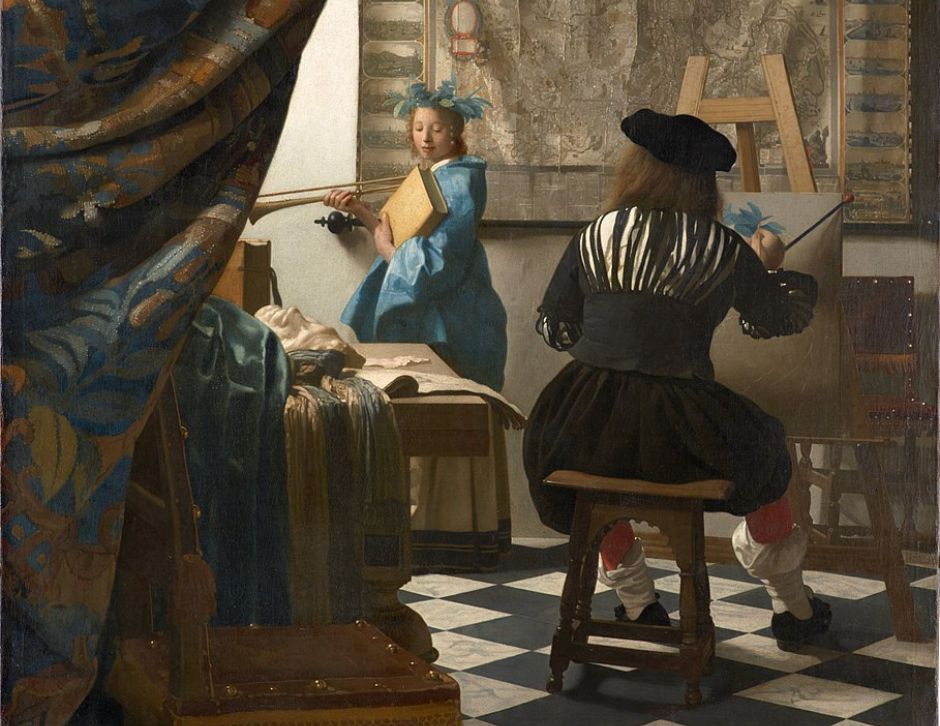
Jan Vermeer effortlessly integrates the perfection of light, complex composition, and naturalistic scenery in The Art of Painting. The woman acts like the model of the painter. She wears a blue dress with her eyes gazing down and a book in her hand. On her back, the wall displays a map of countries. Besides, the table carries some silky cloths on its shelf with shining colorful curtains covering the panorama. A black garment reveals the painter’s shirt underneath the cuts on the sleeves and back. Orange stockings and puffy shorts adorn his legs.
There is a rendering effect of light in the painting, filling it with energy and positivity. The artwork had a special place in Vermeer’s heart, so he did not sell it even when he was in debt.
The map tells us about the history, probably about the ongoing war at that time, with the lady as the description of it through the poetry. The mastery of the colors and representation of his work lies in this composition as well.

10. Mistress and Maid.
This composition of Johannes Vermeer depicts an elegant mistress and her maid discussing a love letter they received. Throughout the scene, yellow dominates the woman’s graceful fur-lined overcoat, and blue dominates the maid’s apron and silk tablecloth. Adding pearls to her wardrobe, the mistress looks stunning. Her hair is nicely tied in a bun. She is probably writing a letter to her lover. Those days when the letter was so prevalent, it was a notable element in all of Jan’s works.
The conversation between the maid and mistress may be about the unknown letter they received. The dilemma about the letter is highlighted through the expressional anatomy of the subjects.

11. Girl With a Red Hat.
This painting by Jan Vermeer portrays a woman with a red fur cap and a pearl earring. The blue dress shows a gleaming pigment with a white contrast. Furthermore, the background includes a painting with green colors dominating.
The expression on her face conveys innocence and confusion as she tries to answer the question. Throughout Vermeer’s paintings, he displayed domestic scenes of a woman with rich colors. The complexities of Jan Vermeer’s work lie in focussing on one subject with enriched details and genres.

Final Words.
Johannes Vermeer is undoubtedly one of the finest craftsmen of the Dutch Golden Age of Art. Through his limited artworks, he spoke many emotions and words. Though he focuses primarily on women and domestic scenes, he somehow manages to capture some beauty and depth in the most neglected worlds. Vermeer paintings have simple subjects, but the mastery of his complexities in the foreground and usage of lights are the essential takeaways.
Let me know which of his artworks inspired you the most and why.
Resources.
- Vermeer by Roberta D’Adda.
- Johannes Vermeer, National Gallery of Art.
- Vermeer of Delft: His Life and Times by Michel P. Van.
- Featured Image: The Art of Painting by Johannes Vermeer; Johannes Vermeer, Public Domain, via Wikimedia Commons.
Frequently Asked Questions.
The Girl With a Pearl Earring was auctioned in 1881 to Arnouldus Andries des Tombe for 2 Guilders and 30 cents. As the buyer had no heirs, the painting was donated to the Mauritshuis in 1902 and has since been never sold, making it priceless.
One of the crucial artworks of the Dutch Golden Age, the Girl With a Pearl Earring was owned by Arnouldus Andreis des Tombe from 1881 to 1902 until it was donated to Mauritshuis, where it now permanently resides.
Johannes Vermeer went unknown for two centuries for his lack of mention in the famous 17th-century Dutch painting sourcebook Grand Theatre of Dutch Painters and Women Artists. However, Gustav Friedrich Waagen and Theophile Thore-Burger published an essay with 66 pictures of the artist, taking credit for rediscovering the artist and his works in the 19th century.
Catharina Bolnes was the wife of Johannes Vermeer. She was the daughter of Maria Thins, belonging to a Catholic family, and Reynier Bolnes, a prosperous brickmaker.
It is not clear whether or not Johannes Vermeer painted Catharina. However, art historians addressed that half of her models were pregnant, and Catharina had 15 children, 4 of whom died prematurely. Hence, one can predict that few of his artworks portrayed her, especially the Girl Reading a Letter at an Open Window.
Johannes Vermeer lived in the city of Delft. In 1631, he lived in an inn called, The Flying Fox with his family. However, after his marriage to Catharina, he moved to his mother-in-law’s house in Oude Langendijk, next to a hidden Jesuit Church.
Griet was a maid and a source of inspiration for several Vermeer paintings. Stories say that she was in love with the artist; however, as Vermeer was married to Catharina, he never contested a physical intimacy and showcased his romanticism toward Griet through his artworks.
The girl in the artwork is the 16-year-old Dutch maid Griet who adored Johannes Vermeer. The painting is also popularly called the Mona Lisa of the North.
Related Reads.


